Ziyang Zhang has been awarded the NIH Director's New Innovator Award for exceptionally creative early career scientists proposing innovative, high-impact projects.
In the diagnostic test, a patient sample is mixed with CRISPR Cas13 proteins (purple) and molecular probes (green) which fluoresce, or light up, when cut. When coronavirus RNA is present in the sample, it prompts the CRISPR proteins to snip the molecular probes, causing the whole sample to emit light. This fluorescence can be detected with a cell phone camera. (Image courtesy...
The Berkeley Chemical Biology Graduate Program began as a way to support students as they rotated through different labs. Now, 20 years in, the program has grown far beyond a series of lab rotations. The 15 to 20 students who join the program each year – coming from both the Division of Chemistry and the Department of Molecular and Cell Biology – can expect in-depth mentoring, coursework, speaker series and symposia that prepare them for a range of jobs. The program has proudly served as a blueprint for many other institutions building their own chemical biology programs. While grant...
A new study from the labs of Professors S. Lawrence Zipursky (UCLA) and Karthik Shekhar (UC Berkeley) presents "significant findings that shine an exciting light on our understanding of the influence of vision during the critical period of development in the mouse visual cortex.”
John Hartwig (Ph.D.’90, Chem), is the Henry Rapoport Professor in Organic Chemistry at UC Berkeley. He joined the senior faculty at the College of Chemistry in 2011. His research group is focused on the discovery and understanding of new reactions of organic compounds catalyzed by transition metal complexes and artificial metalloenzymes. Among the many potential applications are catalysts for pharmaceuticals, renewable chemicals, and fuels.
Hartwig did his graduate research at UC Berkeley with advisors Robert Bergman...
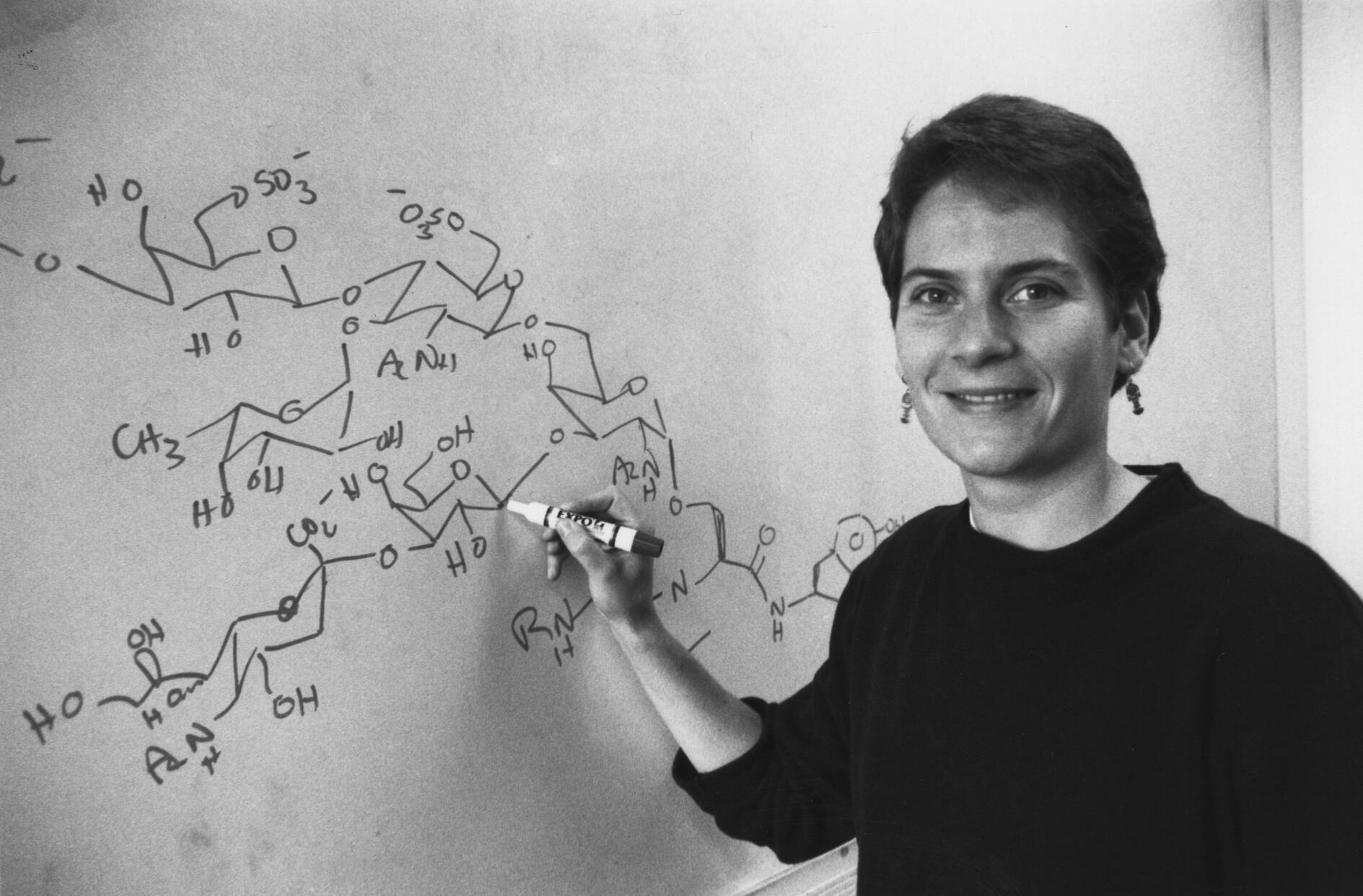
Carolyn Bertozzi as a young professor at UC Berkeley. (Photo: courtesy of College of Chemistry)
Carolyn Bertozzi, a professor at Stanford University who today shared the 2022 Nobel Prize in Chemistry, spent her formative and most creative years at UC Berkeley.
After graduating from Harvard University in 1988, she earned her Ph.D. in chemistry...
Finding Archaea: Archaeans inhabit some of the most extreme environments on Earth. Woese and Fox’s genetic analysis led them to redraw the Tree of Life, incorporating this third domain. (Photo: Morning Glory Pool, Yellowstone National Park; Jim Peaco; March 2015; Catalog #20008d.)
Sarah C.P. Williams | Heising-Simons Faculty Fellows Program
Ke Xu, Associate Professor of Chemistry, is a 2021 Heising-Simons Faculty Fellow. (Photo by Elena Zhukova)
What do the smallest building blocks of life look like? How do molecules dance and dart and drift through cells, fold and fuse and form the machinery of living things? For...
UC Berkeley business and chemistry alumni Geo Guillen, left, and Marco Lobba, middle, launched Catena Biosciences with Berkeley chemistry professor Matthew Francis. The trio credit Berkeley’s entrepreneurship ecosystem for their company’s rapid rise. (Photo courtesy of Catena Biosciences)
Marco Lobba was five years into his UC Berkeley chemistry Ph.D. program...